Garlic Mustard: Tempting

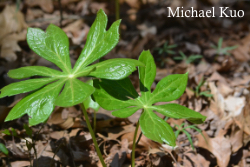
Garlic mustard I spotted on my noon hour walk.

Garlic mustard I spotted on my noon hour walk.

Some year’s ago, I read a book titled, “The Myth of the Greener Grass”. In addressing the problem of marital infidelity, the author, J. Allan Petersen, made the argument that, “The appeal of temptation is always to satisfy a legitimate need in a wrong way or at a wrong time.

These words have stuck with me over the years and have been applied to more than just my marriage. We are often tempted to manipulate all sorts of circumstances to appeal to our needs, legitimate and otherwise. Such actions tend to result in all sorts of unintended consequences.

So we find that we’re also tempted to manipulate nature to satisfy a legitimate needs whether on a macro or micro-biological level.  As pointed out in an earlier post, settlers brought dandelions with them to the New World in order to attract pollinators to their crops and thus ensure more productive harvests. However, introducing non-native species resulted in a case of – the wrong plant in the wrong place.

Another such nuisance, garlic mustard (alliaria petiolata), originating in Europe, was first recorded in the United States on Long Island, New York in 1868. The leaves do make a nice addition to a salad if harvested early in the growing season. But it’s there that they cease to be of any value.

As with all invasives, the problem is not so much their presence as it is their dominance over native plants. Garlic mustard displaces native spring wildflowers like spring beauty, wild ginger, bloodroot, trilliums, and toothwort. In inhibiting the growth of other plants, wildflowers, even trees, they  impact the survival of native animal and insect species that rely on them for food and habitat.

Each season one mustard garlic weed produces hundreds of fine seeds which are carried nearby and multiply the following spring. Although they are the most prevalent in the Northeastern US, they are also found in the Midwest, Southeast, western states and Alaska.

Eradication is particularly difficult as seeds can survive for five or more years before germinating. This means that repeated hand removal, along with the roots, must take place over multiple years before the seed matures and is scattered.

Wrong way, wrong time, wrong place. We need to ask ourselves just how much we ought to manipulate nature to meet our needs. Temptation can be a powerful force, but there is always a price to be paid.


“Eh Mon, What Are Those Pretty Flowers?”

The ubiquitous dandelion - blessing or curse?

The ubiquitous dandelion – blessing or curse?

A couple of years ago, some Jamaicans were visiting a friend in Illinois. It was the month of May and as they traveled down a country road, one of the Caribbean guests spotted the endless masses of yellow dandelions (taraxacum officinale) and asked, “Eh Mon, what are those pretty flowers?” My friend, who grew up in the Midwest could hardly believe his ears. Pretty flowers? To avid gardeners “pretty” has nothing to do with it. They are simply a curse.

Whether or not they are in fact a curse is a matter of perspective. To the pilgrims, who brought them with them to the New World, they were a help in attracting pollinators to their orchards and gardens. That’s right, dandelions are not native to North America. As is the case with numerous botanical species, they were imported from elsewhere. But in addition to attracting pollinators, dandelions serve a number of other functions.

According to an article posted by the University of Maryland Medical Center, dandelion leaves act as a diuretic, increasing the amount of urine the body produces. The leaves are used to stimulate the appetite and help digestion. Dandelion flower has antioxidant properties. Dandelion may also help improve the immune system.

North American Indians understood this and boiled dandelion in water and took it to treat kidney disease, swelling, skin problems, heartburn, and upset stomach. In traditional Chinese medicine, dandelion has been used to treat stomach problems, appendicitis, and breast problems, such as inflammation or lack of milk flow. In Europe, it was used in remedies for fever, boils, eye problems, diabetes, and diarrhea.

Herbalists use dandelion root to detoxify the liver and gallbladder, and dandelion leaves to support kidney function. Dandelion is a rich source of vitamins A, B complex, C, and D, as well as minerals such as iron, potassium, and zinc. Dandelion leaves are used to add flavor to salads, sandwiches, and teas. The roots are used in some coffee substitutes, and the flowers are used to make wines.

Jeremiah 33:6
Behold, I will bring to it health and healing, and I will heal them and reveal to them abundance of prosperity and security.

Should you decide to head outside and harvest some dandelions, let me make one precaution – don’t harvest dandelions from an area that has been sprayed with herbicides. Look for the ones growing in an open meadow. They’ll be strong and healthy, measuring as tall as 12 inches in some cases.

So if that doesn’t change your perspective, take it from the herbicide companies – dandelions may just be one of the most beautiful flowers in the whole world.


Virginia Spring Beauty – Prolific and Edible

The hardy and yet tasty spring beauty.

The hardy and yet tasty spring beauty.

I’m still getting out for my lunch hour walks and finding new spring wildflowers popping up everyday. The trout lilies that were in abundance just a few days ago are no more and the red trilliums still need a few more days before they will bloom. But today the virginia spring beauties (Claytonia virginica), one of the most common native perennials in eastern North America, are out in full force. They should be. After all they are one of the most prolific spring wildflowers in Indiana.

Spring beauties are small low-growing wildflowers that are found in a star-like cluster of five white to light pink flowers. Closer examination of the petals will reveal an array of fine pink stripes and a pleasant floral fragrance. The dark green, grass-like leaves are both narrow and linear, and are usually found in pairs.

Foliage continues to grow after bloom and may eventually reach close to a foot tall before the leaves disappear in late spring as the plants go into dormancy. 

One reason for why the spring beauty is so common is its ability to survive in areas that have suffered land degradation such as livestock grazing and partial tree removal. Many other native woodland wildflowers don’t fare as well under these conditions. The spring beauty however, can thrive in yards with just a few trees present and be quite prolific. When spring beauties and other wildflowers are absent from woodlands, this is a sure sign of severe degradation from plows or bulldozers in the past.

Beautiful and Tasty?

According to the Brooklyn Botanic Gardens, spring beauties are not only beautiful spring ephemerals, but a tasty spud-like vegetable. The tubers, or the fleshy underground stem or root that provides nutrition to the plant, are a half inch to two inches in diameter, and are often compared to radishes or small potatoes. They taste, however, much sweeter than the average spud – more like a chestnut than potato – and are rich in nutrients including potassium, calcium and vitamins A and C.

Spring beauty tubers are best harvested when the flower is in full bloom. Though you may be tempted to grab a few bunches on your next hike, wildflowers should be left in the wild to be enjoyed by all. Instead plant this wonderful native and edible plant in your own backyard. As a native perennial, spring beauties are quite easy to grow and maintain. Whether baked, roasted or eaten raw, spring beauties are a yummy and unique snack that looks just as good in your garden as they do on your plate.

Job 37:6-7 He says to the snow “Fall on the earth,” and to the rain shower, “Be a mighty downpour.” So that all men he has made may know his work, he stops every man from his labor.

Sources: Nature Conservancy, Guide to Indiana Wildflowers

What Can We Learn from Creation?

DT3190.jpgIn Psalm 24:1, we’re told, “The earth is the Lord’s and everything in it”. This tells me that there is a connection between the creator and his creation and that if I want to learn more about one or the other, I can do so by observing one or the other.

This isn’t to say that simply observing God or reading a Bible will provide me with an exhaustive understanding of the created world, just as observing nature will not provide me with a complete picture of God and his nature. But there is an overlap, just as learning about the parent may inform you about the child and vice versa.

A 1975 study of Hanunóo tribe in the Philippines, found that the average adult from the tribe could identify 1,600 different species – all without the help of botanical science. These people had knowledge of some 400 more plant species than were previously recorded in a modern systematic botanical survey. What’s more, they also knew how to use there plants for food, construction, crafts, and medicine. And they knew where to find all of them – they knew the plant’s habitats and their ecology.*

Calvin B. DeWitt in in his book “Earthwise” points out that the ability to build mental models and images of all aspects of creation – from atoms to plants to habitats to the cosmos – is essential for meaningful human life. These models, he suggests, are nurtured, transferred, and refined by our human culture, which is also a gift from God.

Henri Nouwen, a Dutch-born Catholic priest and writer summarized it well when he wrote, “It is through creation that we come to understand God’s glory, it is through God’s word, that we understand his grace.”

The apostle Paul used a few more words to express the same in Colossians 1:15-20:

He is the image of the invisible God, the firstborn of all creation. For by him all things were created, in heaven and on earth, visible and invisible, whether thrones or dominions or rulers or authorities—all things were created through him and for him. And he is before all things, and in him all things hold together. And he is the head of the body, the church. He is the beginning, the firstborn from the dead, that in everything he might be preeminent. For in him all the fullness of God was pleased to dwell, and through him to reconcile to himself all things, whether on earth or in heaven, making peace by the blood of his cross.


* Awa, N. “Participation and Indigenous Knowledge in Rural Development” Knowledge 10″304-316, 1989.


Are “Green” Cars Really Green?

The electric car's dirty little secret

The electric car’s dirty little secret

Car manufacturers are busy jumping on the “green” bandwagon coming up with a variety of new initiatives. While there certainly some new developments that have reduced fuel consumption, some of the most dramatic are misnomers. One such example is the electric car.

According to Bjorn Lomborg of the Wall Street Journal, electric cars “have a dirty little secret”. He goes on to explain that before an electric car leaves the showroom, it has produced 30,000 pounds of carbon dioxide, mostly in lithium battery production- about 16,000 pounds more CO2 than a conventional car.

In addition, electric cars require recharging, and of course that means using electricity powered overwhelmingly by fossil fuels.

He goes on to explain that to emit less overall CO2, the electric car must be driven at least 80,000 miles. But because electric cars need frequent recharging, their owners tend to only use them over short distances. So most electric-car owners don’t rack up that much mileage, and even if they did, we would still have to deal with the matter of disposal.

Once again we find that things are not always as they might seem, or what we would like them to be. While it’s good to see manufacturers developing battery technologies that may one day reduce our carbon imprint, there is no doubt we have not yet arrived.

Someday electric cars may actually replace gas vehicles, but as a means of tackling global warming right now, it accomplishes very little.

Celebrating Contendedness

Trout Lily on the campus of Huntington University

Trout Lily on the campus of Huntington University

I’ve been challenged recently to think more about what it means to be content in reference to my possessions, circumstances and future. The nudge has come in part from the example of one of my daughters who has been working to instill this virtue in her life and that of my grandchildren. Contentedness – not a highly valued concept in a success-driven, power hungry, materialistic society.

So today as I got out for a walk over lunch (something I’ve recently been working harder to do more religiously) I came across a patch of trout lilies on the campus of Huntington University located right next door to my office.

In addition to being one of my favorite native wildflowers, trout lily (erythronium americanum), is said to derive its name from the speckled leaves, similar in appearance to the speckled skin of a trout. It generally grows in groups of dozens to hundreds of plants and as is the case with dutchman’s breeches, is an ephemeral wildflower that appears for just a short time and then is gone again for an entire calendar year.

It was while viewing this tiny lily that the words of Jesus came to mind, “Consider the lilies, how they grow: they neither toil nor spin, yet I tell you, even Solomon in all his glory was not arrayed like one of these.” Luke 12:27

How often I miss out on the richness of life that is on display wherever I look. Here on the forest floor, lies a simple lily that rivals the splendor of King Solomon’s royal vestments in all their magnificence. It did nothing to gain it’s beauty other than grow where it was planted and become what it was intended to be. Nothing more, nothing less.

I suppose it’s no coincidence that on Earth Day 2013, I would be reminded again of just how truly rich I am if I just stop for a moment and look around. It’s time to stop toiling for what I don’t have, or wish I was, or believe I deserve, and simply accept what has already been provided.

If God can provide such marvelous clothing for a tiny flower on the forest floor that is here today and gone tomorrow, how much more will he care for me.

Early Wildflowers

Dutchman's Breeches at Fox Island Park - Fort Wayne

Dutchman’s Breeches at Fox Island Park – Fort Wayne

It seems the wildflowers are running just a little behind this year. Perhaps it’s my impatience, or perhaps it’s been the cold weather, overcast days and only recent arrival of that “magic potion” – rain.

Whatever the reason for the seeming delay, it was great to see from Dutchman’s Breeches out at Fox Island Park in Fort Wayne this afternoon.

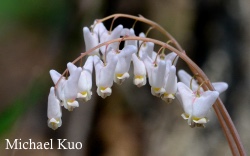
Dutchman’s Breeches (dicentra cucullaria) is an herbaceous perennial of the Fumariaceae family. This species has many common names depending on which part of the country you come from. One of its common names, Little Blue Staggers, is derived from its ability to induce drunken staggering if cattle graze on it, due to narcotic and toxic substances in the poppy-related genus. Bleeding heart is another common name.
This native wildflower is common throughout the eastern United States though rarer in the Pacific Northwest. The western populations of Dicentra cucullaria appear to have been separated from the eastern ones for at least one thousand years according to the Flora of North America. According the the US Forest Service, the western plants are somewhat coarser in appearance but generally indistinguishable from their eastern counterparts. In Idaho, the species often grows along stream corridors in gravely banks well above the waterline. It is also occurs in Washington and Oregon.

Dutchman’s Breeches blooms in the early spring from March to April. Flowers are white to pink and resemble a pair of pantaloons hanging upside down (whence the common name).

As is true with many wildflower, the flowers wilt almost immediately upon picking so they should not be collected in the wild. The one or more finely compound leaves make the plant appear fern-like. This perennial species has rice-like seed bulbs and is an attractive addition to any garden in moist shady areas.

What is perhaps most amazing about native wildflowers is rather short period of time during which which they flower and are pollinated. Biologist would call them “ephemerals”, which simply means to last a short time. Some wildflowers have just three days to attract pollinators before their flower falls and they shrink back into waiting for another 362 days.

So before the trees leaf out and shade the forest floor for the rest of the season, be watching for these patient wildflowers. Though their moment in the sun is but a few days, they shine nonetheless and bring hope to all those who have endured yet another winter.

Follow

Get every new post delivered to your Inbox.

Join 75 other followers